Toni Jackson
Counselling & Psychotherapy for the Misunderstood

Healthy Boundaries Are Your Super Power

Sitting in her office at the No. 1 Ladies’ Detective Agency, Mma Ramotswe reflected on how easy it was to find oneself committed to a course of action simply because one lacked the courage to say no.
Difficulties with boundaries is something I encounter a lot with the people who come to see me for counselling in Fremantle, Mundaring and online.
If we grew up in a home where healthy boundaries were not role modelled for us, we may have picked up some less-than-empowering beliefs about how to set healthy, adaptive boundaries.
This article will look at:
• What is a boundary?
• Types of boundaries
• Your body always knows your boundaries
• When we override our body signals
• Why is it so difficult?
• How to have healthy boundaries
• Brene Brown on boundaries
• Cool boundary experiment
What is a Boundary?
Brene Brown describes a boundary as simply “what’s okay and what’s not okay” for us.
Healthy boundaries allow us to protect ourselves. When we don’t have great boundaries, we may feel we are constantly bending to the wishes of others. This usually leads to exhaustion, stress, resentment and an overall sense of disempowerment.
If we are unable to assert our boundaries in a healthy manner, most of us will eventually become either aggressive or withdrawn as a way of protecting ourselves. Compromising ourselves in these ways can lead to anxiety and depression.
A boundary may be rigid, porous or flexible. The nature of our boundaries will change depending on who we are with and the context of the situation. Read More
Grounding: What To Do When You Feel Unstable

You know those moments when you feel like you’ve lost your footing? When you feel spacey, wobbly, scatty and unclear? It can happen when we are stressed, overwhelmed, anxious, or too far out of our comfort zone. Knowing how to ground ourselves in such situations, can make a huge difference to how we feel.
In this article, we look at:
- What is grounding?
- How grounding helps.
- How to ground yourself to feel calmer.
- Further grounding resources.
What is Grounding?
To ground ourselves is to do any activity that makes us feel solid, centred, balanced, contained or connected to ourselves – particularly to our body. It literally means, connecting to the earth.
I think of it as a ‘coming home’ to ourselves. It is a way to anchor ourselves down when we feel like we’re disconnecting. Grounding brings us back into our personal power.
When we ground ourselves, we are directing our attention and our energy downward, toward our bodies and the earth. In comparison, when we feel ungrounded, or flighty, our energy and attention is focused upward, away from the ground and our bodies. In this case, we are either too much in our heads, or have abandoned ourselves altogether – we have dissociated.
Sensorimotor Psychotherapist Pat Ogden, describes grounding as “a felt sense of connection to the ground” and as “the capacity to direct somatic energy toward the ground.” Read More
Books To Help You Befriend Your Body

I recently contributed to an article on 20 Powerful Books To Help You Befriend Your Body, edited by Soul-Centred Psychotherapist and Eating Psychology Specialist Jodie Gale. The article is a wonderful resource of books reviewed by therapists who work with the mind-body connection.
Jodie says, “Increasingly, many of us feel a sense of alienation, disconnection, a lack of safety, and insecurity within our bodies. At the core, this sense of dis-ease can often be the result of early childhood attachment and interpersonal ruptures, emotional neglect and/or trauma.”
In their own, unique ways, these books offer gentle paths for reconnecting with our bodily selves. Helping us to feel grounded and centred within ourselves. To read about all 20 books, click here.
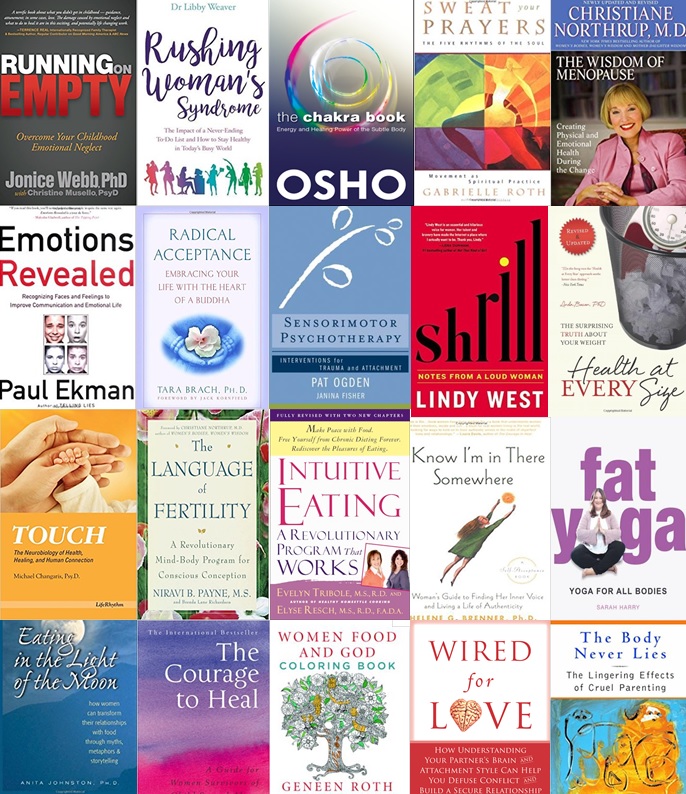
Image credit: Jodie Gale
About Toni Jackson
I am a psychotherapist, counsellor and creative therapist, in Perth, Fremantle and Mundaring, Western Australia. I specialise in working with women around the issues of self-worth, anxiety, body image and personal power. I am a certified Gestalt Therapist, with a BA Psychology and a Grad. Dip. Women’s Studies. I have a strong interest in trauma therapy and use both body awareness and art therapy in my work.
If you would like to book an appointment, please contact Toni Jackson.
Phone: 0439 995 302
Email: toni@tonijacksoncounselling.com
 Toni Jackson